Real-Time Policy Evaluation
Evaluates every execution request from AXIOM and PRAETORIAN against active mission policy in sub-millisecond time, returning a cryptographically signed authorization or a structured denial with traced rationale.
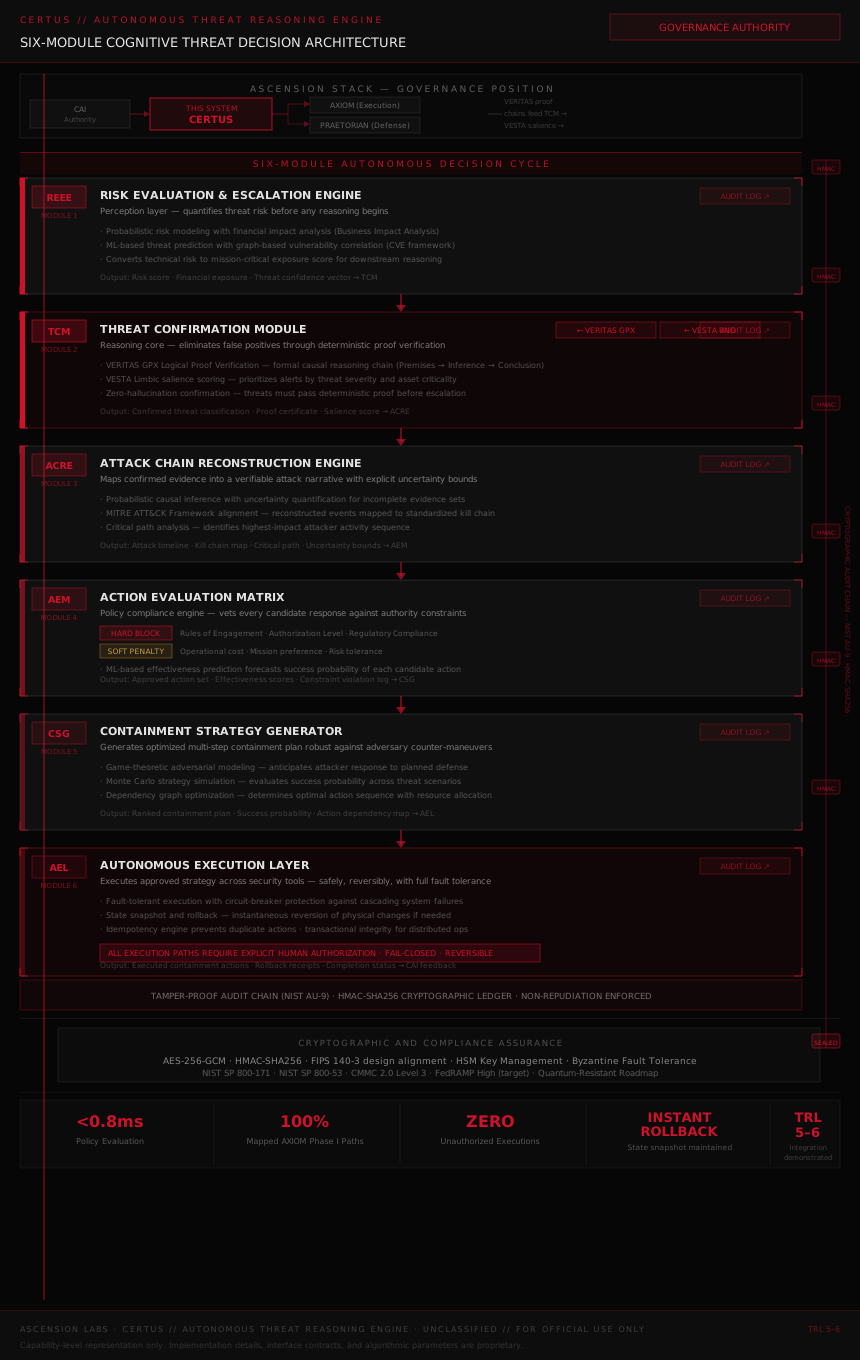
The compliance backbone of the Ascension architecture — a real-time policy enforcement engine that gates every execution path in the stack. Mapped execution paths are designed to require CERTUS authorization. Subsystem operation is designed to remain within defined policy boundaries.
CERTUS defines the boundary between controlled autonomy and unconstrained autonomy. It is not an advisory system — it is an enforcement system. Policy violations are not logged and allowed. They are blocked at the architectural level before any execution path is activated.
Evaluates every execution request from AXIOM and PRAETORIAN against active mission policy in sub-millisecond time, returning a cryptographically signed authorization or a structured denial with traced rationale.
Policy constraints defined at the mission level are automatically propagated to all subsystems at runtime, ensuring that governance rules are dynamically enforced as mission parameters evolve.
High-risk or irreversible actions require staged approval sequences with configurable authority thresholds, escalation paths, and human-in-the-loop override integration points.
NIST 800-53, CMMC 2.0, and mission-specific policy frameworks are encoded as executable constraint sets, enabling continuous compliance verification without manual audit cycles.
CERTUS receives policy directives from CAI and mission-level constraint sets from authorized configuration inputs. It operates in parallel to the decision pipeline — evaluation happens concurrently with cognitive processing, not after it.
Acts as a perpetual gate across every execution path in the system, maintaining active policy state for all subsystems simultaneously. Denial events are logged, traced, and surfaced to CAI for cognitive state adjustment.
AXIOM cannot execute without CERTUS authorization. PRAETORIAN cannot initiate defensive actions without governance approval. CERTUS-signed authorizations include expiry bounds, scope limits, and reversibility classifications.
CMMC/NIST-aligned governance for defense contractors and federal programs requiring continuous compliance assurance.
Operational boundaries for autonomous systems that must demonstrate governance-bound behavior under independent review.
Dynamic policy reconfiguration as mission parameters shift, with full audit trail of constraint changes and authorization scope modifications.